ISSA 2026 – Year four
Article by Mira Oklobdžija
(Čitaj na našem jeziku)
Many people, except those with an unshakable belief that human is a tree with firm roots, travel around the places of their physical origin in smaller or larger circles. Some dare to venture farther away, eventually returning or just remembering the old space. Ivan Illich, a priest, theologian, philosopher and radical social critic whose ideas were close to anarchism, grew up on the island of Brač and lived in New York, Puerto Rico, Mexico, and Germany. Later in life, he returned to the Adriatic, not in search of some abstract roots but traditional Dalmatian, slow-paced lifestyle, characterised by the term ‘conviviality’, as the antithesis to the dangerously accelerating, competitive capitalist one. In September 2026, on the 100th anniversary of Illich’s birth, his spiritual descendants gathered on a few Adriatic islands to discuss his intellectual gifts and their importance today.

Ivan Illich was one of the most powerful and original voices when it comes to the critique of modern institutions. Concerning education, he argues in his internationally known book “Deschooling Society” (1971) that we learn by doing, unlearning, experimenting, and teaching each other. Every person has something to offer and share with others. In contrast, modern society’s institutional approach to education demotivates and alienates individuals from the process of learning, while presenting a kind of dressage for obedient vassals of a society that doesn’t respect freedom. Illich opposed not merely publicly funded schooling, but schools as such. Further, in the book “Medical Nemesis” (1975) he subjected contemporary Western medicine to detailed scrutiny, arguing that the use of medicines frequently causes more harm than good and renders a lot of people in effect lifelong patients. Over-medicalization and modern healthcare systems create “iatrogenesis” (medical harm), turning normal life processes into medical problems and making people dependent on experts. But Illich was never satisfied with critique alone; his work offers clear alternative for education, use of medicine and ways of life.
Approaching his concept of ‘conviviality’ which was central to this year’s gathering on the islands, it is helpful to remember the term, ‘stranger’, that Illich dealt with frequently. For him, a stranger is not a threat or a category to manage, but an unexpected neighbour whom we freely choose to love through a personal, unforced encounter. Relatedly, the term xenophobia refers to the natural or cultural fear of the stranger (or anything new, still unknown). In Illich’s ideas we readily detect his open-hearted, humanistic approach, which many can find overly optimistic and not always based on known scientific analyses concerning human nature. But, especially today, it is refreshing to read his pledge for the openness and welcoming of the stranger, rather than hiding behind the walls or pre-conceives negative believes.
Conviviality is the quality of being friendly, hospitable, and full of cheerful, lively togetherness. As social and political framework it is centred on individual freedom realized through personal interdependence, creative cooperation, and living in harmony with one’s environment rather than through industrial control and endless consumption. For Illich, conviviality was a precise term, not just a synonym for a good, cheerful company sharing a joyful time. It is autonomous, creative interaction between people and their environment, an alternative to industrial productivity and control. In “Tools for Conviviality”,1 he reminds us that “The result of much economic development is very often not human flourishing but ‘modernized poverty’, dependency, and an out-of-control system in which the humans become worn-down mechanical parts.” Further, he describes a condition possible only where tools, technologies, and institutions remain uncomplicated enough to be understood, shaped, and repaired by the people who use them, and limited enough to enhance autonomy rather than create dependence. In short, conviviality is “individual freedom realised in personal interdependence”. If we open our eyes we can notice where the tools and systems around us have passed the threshold at which they stop serving us and begin to discipline us.
In his “Silence is a Commons” (1982)2 Illich warns about new and aggressively increasing dangers. “The new electronic devices do indeed have the power to force people to ‘communicate’ with them and with each other on the terms of the machine. Whatever structurally does not fit the logic of machines is effectively filtered from a culture dominated by their use. Observations of the sickening effect of programmed environments show that people in them become indolent, impotent, narcissistic and apolitical. The political process breaks down, because people cease to be able to govern themselves; they demand to be managed.” The rapidly growing fear of an uncontrolled rise of AI has become daily headline news. Noise and speed are dominating the world. Illich has spoken of silence as a prerequisite for human development. “Silence, according to western and eastern tradition alike, is necessary for the emergence of persons”. He illustrates changes brought by modernity, mentioning the first loudspeaker arriving on the island on Brač in 1926, on the same boat as him. According to Illich, this device has destroyed the silence which, till then, had given each man and woman his or her proper and equal voice. We can debate whether these voices have really been equally powerful before, but the point he raises is clear: “Unless you have access to a loudspeaker, you are silenced… We could easily be made increasingly dependent on machines for speaking and for thinking, as we are already dependent on machines for moving.”
Islands of Conviviality, the Adriatic, 2026
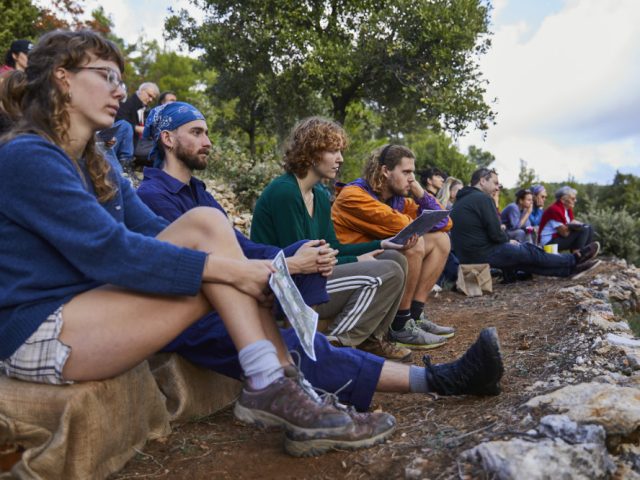
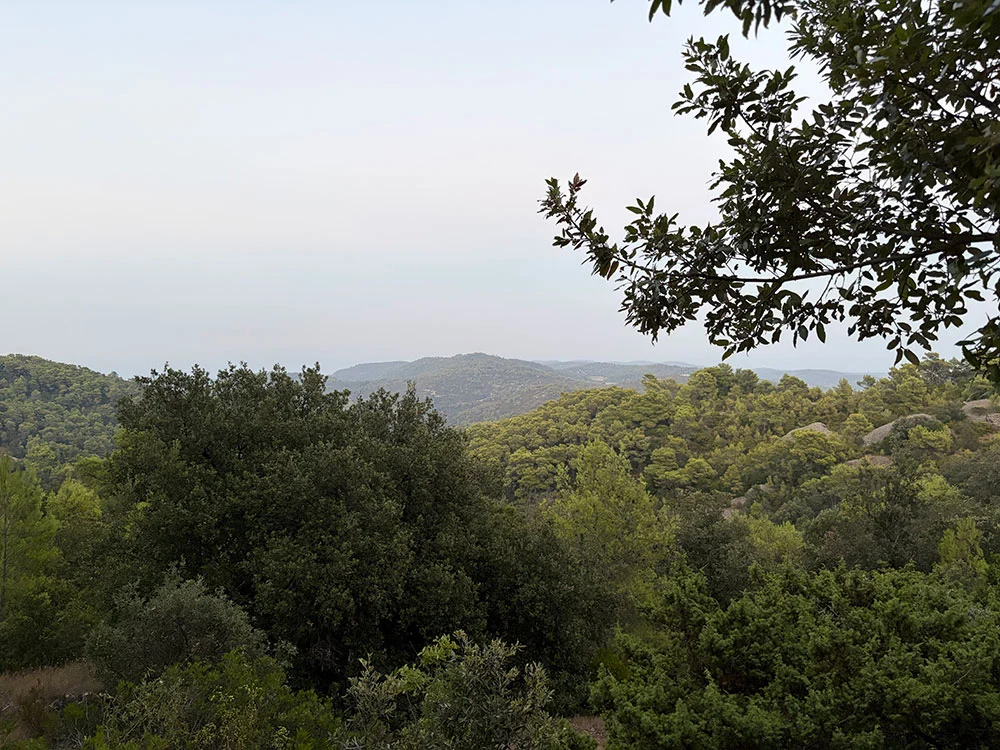
This year’s gathering took place on 1-9 September. Departing from Split, four boats headed to Brač, Hvar and finally Vis where the boats’ crews were welcomed by the founders and friends of ISSA, Island School of Social Autonomy. Inspired by the reflections of Ivan Illich and his concept of conviviality, this collaborative action and research project had as a goal experimenting with social autonomy, relationality, and interdependence. Participants included researchers, artists, practitioners from many countries and island communities. The plan of the organisers was to explore in which way each island carries its own Illichian thread: on Brač, land practices and herbal knowledge; on Hvar, questions of heritage, rest, and different ways of learning; on Vis, at ISSA, the infrastructure of convivial autonomy through solar hosting, intermittent internet, and convivial tools against a world of enclosed and enclosing platforms.3 A number of foundations, associations and institutions of culture as well as some local groups supported and co-organized the project in various ways.4
As described on the ISSA webpage, the main guidelines and collective compass for the participants were to treat shared spaces, resources, and knowledge as commons and to take care of them. The visitors were not to forget that they are guests to the islands, and as such have to engage with respect with the local environment, community and culture. Also, they have been encouraged to strive for meaningful critical dialogue, mapping constructive convergence and divergence, making their conversations reflective while remaining nourishing and caring at all times. The ambition was not just to be participants but, when possible, active practitioners of the desired world to be built, cultivating a space where everyone can feel seen, heard and safe. Addressing mutual well-being has been seen as a political act, so racism, sexism, queerphobia, transphobia, ableism, nationalism, neuronormativity or oppressive behaviour of any kind had no place in or around the project.5
The first gathering took place in Split in ‘Prostor’, where people associated with the Max Planck Institute of Geoanthropology and the Anthropocene Commons joined the discussion. The main theme was a way of thinking about what happens when rivers, seas and boats become not simply subjects of research but means through which people travel, learn and encounter a region together. Yvonne Illich took part by presenting her uncle not principally as the author of famous books, but as a person embedded in a family, a geography, and a complicated European and world history. She offered an extended intervention about the Illich family and their relationship to Dalmatia and spoke about Ivan’s parents and the family’s histories in the region, as well as the different movements, privileges, displacements and difficulties that shaped them. Thanks to her, participants could familiarize themselves with extraordinary family material, including home movies Ivan’s mother had made.
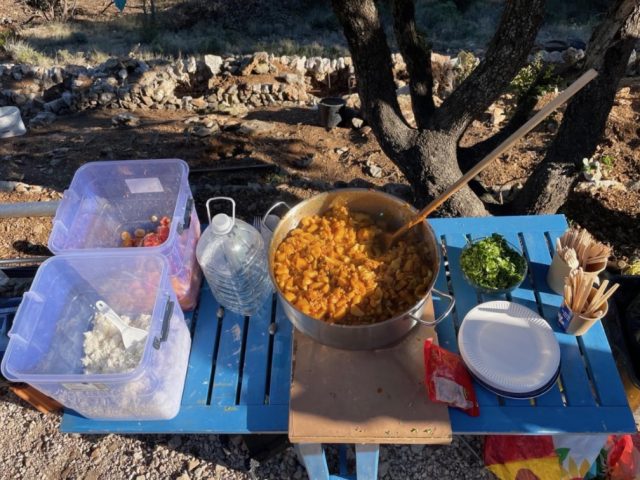
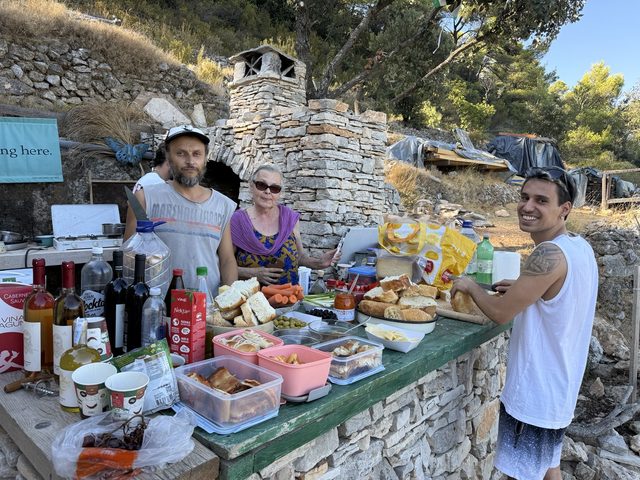
The day after the boats sailed from Split to Bobovišća on Brač. That first passage allowed everybody to become acquainted with the boats and with sailing as a collective endeavour. From Bobovišća the participants walked to Ložišća with Andrea Kegalj, who spoke about the island’s history and infrastructure, as well as her own experience of (recently) becoming an islander, and in the evening Armina Pilav hosted the group at ‘Diva Herbal Crafts, which is also her home. Armina shared her knowledge of the land, plants, foraging, fermentation and food through an extraordinary meal made almost entirely from things available on the island. This event was the first substantial meal together and became an important moment in forming the group.
The next island to visit was Hvar. In Stari Grad, Valeria Graziano, Morana Miljanović and Kevin Kenjar led ‘Radical Holidays: Adriatic as Pleasure Commons’, a walking exploration of the town that asked from the group to think about leisure in historical and political terms. The Adriatic has been a place of rest and recreation for millennia, but the walk also opened consideration about Yugoslav histories of workers’ holidays and holiday infrastructure, and the possibility that leisure itself might constitute a commons rather than simply a commodity. Arka Kinari, a 70-ton sailboat that acts as a floating cultural platform, on a voyage to promote resilience to climate change and re-engagement with the sea, was docked at Stari Grad and opened its deck for public visits. This generated another set of conversations about artistic practice, voyaging and relationships with local communities: what happens when an artistic project arrives somewhere by sea? How does it encounter the people already there? What does an ‘international art world’ see in such a project, and what might local communities think of it?
Jamie Allen, artis, researcher and coordinator of the event uses the term ‘research procession’ to describe the program and its different layers including sailing, walking, eating, repairing, listening, discussing, making, working, swimming and spending time together. “A procession has direction without necessarily knowing exactly what it will discover, and it’s about collecting strangers along the way and including them. People can enter and leave it. It moves through places rather than extracting them as objects of study. And the people involved can continually change roles: researcher, tourist, presenter, listener, host, guest, sailor, cook, worker, friend. …. I become more and more interested in the idea of hospitality as a form of knowledge. The person who helps you enter a place differently, and even in a way that is (at first) unwelcoming, is a teacher.”
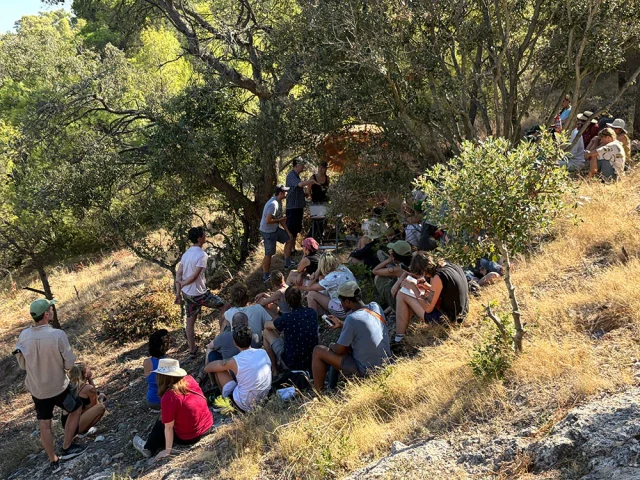
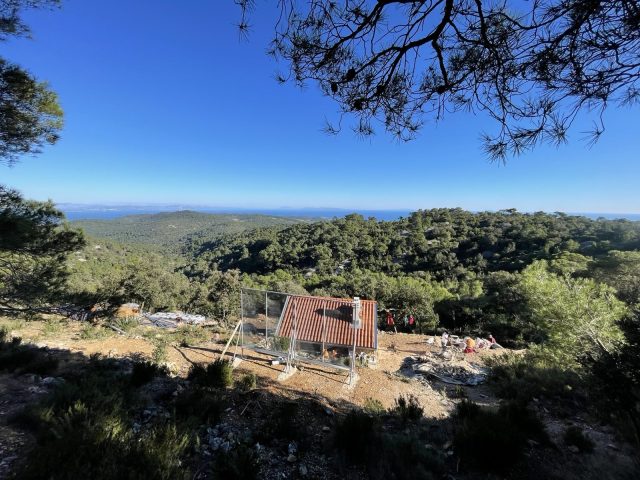
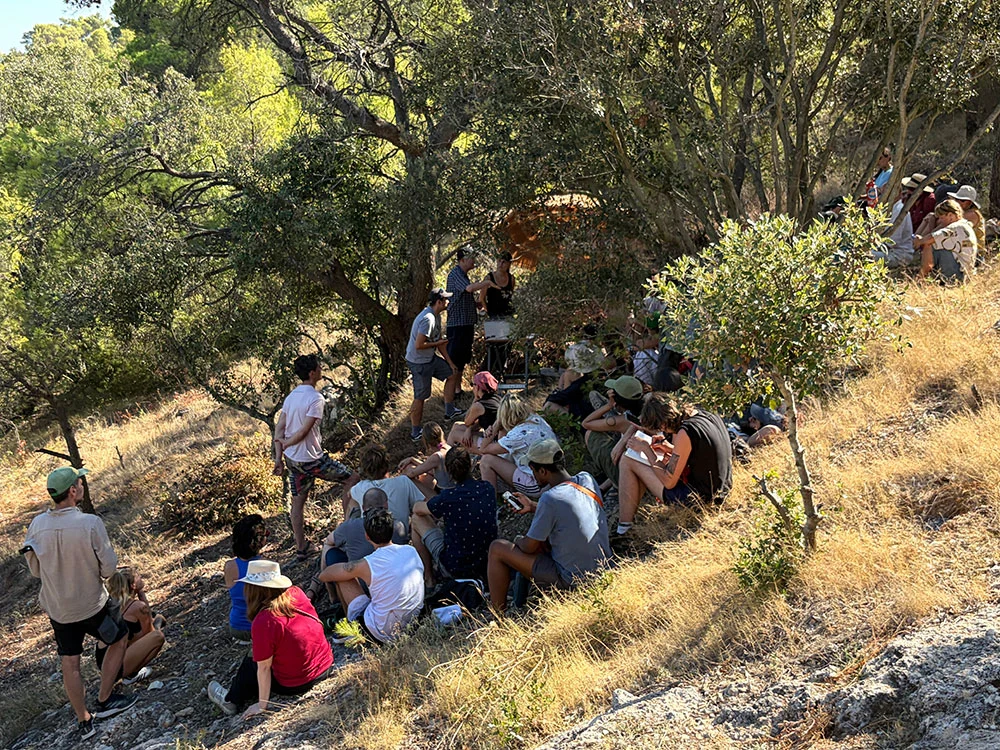
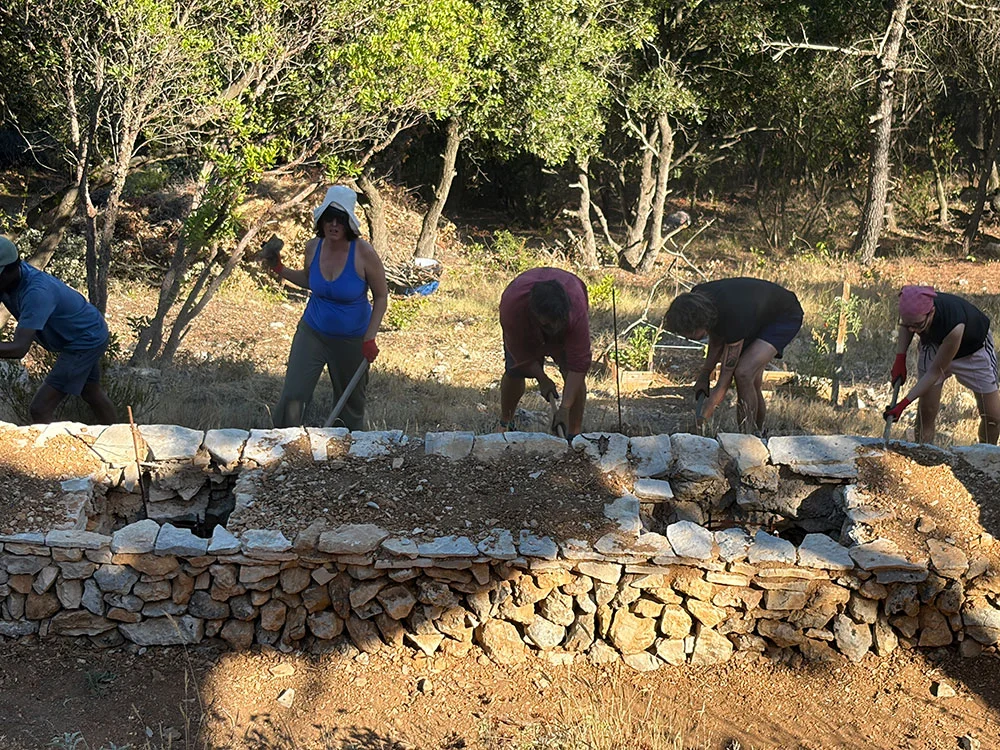
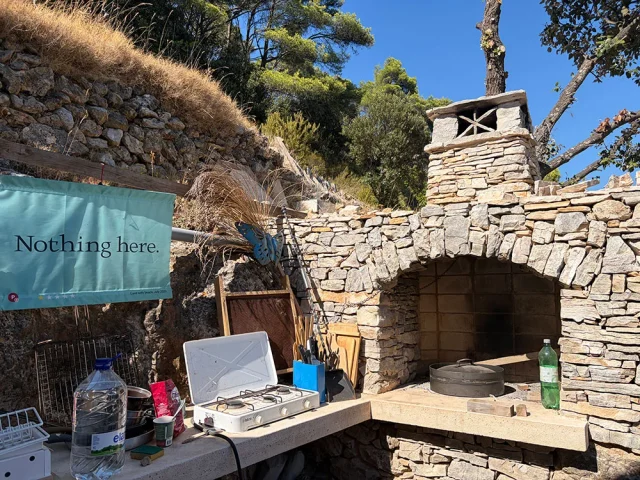
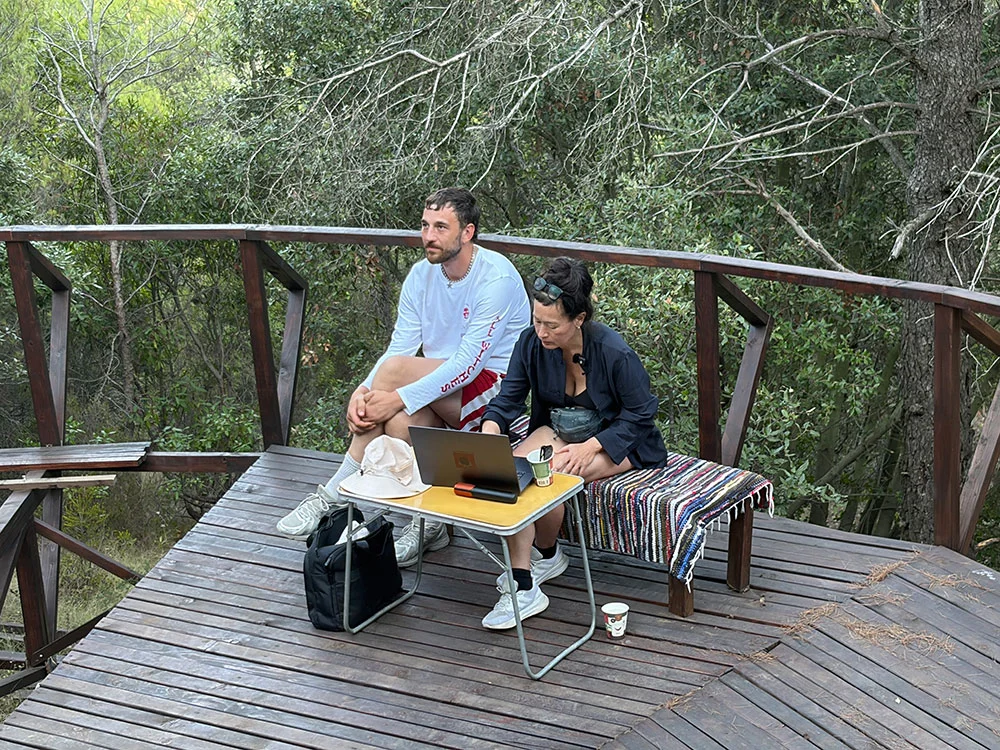
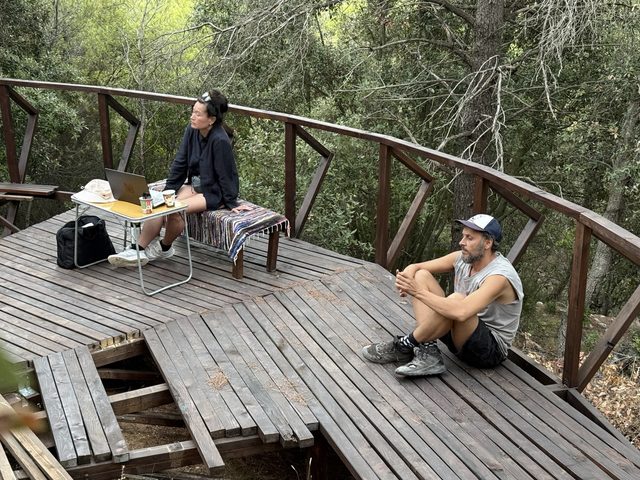
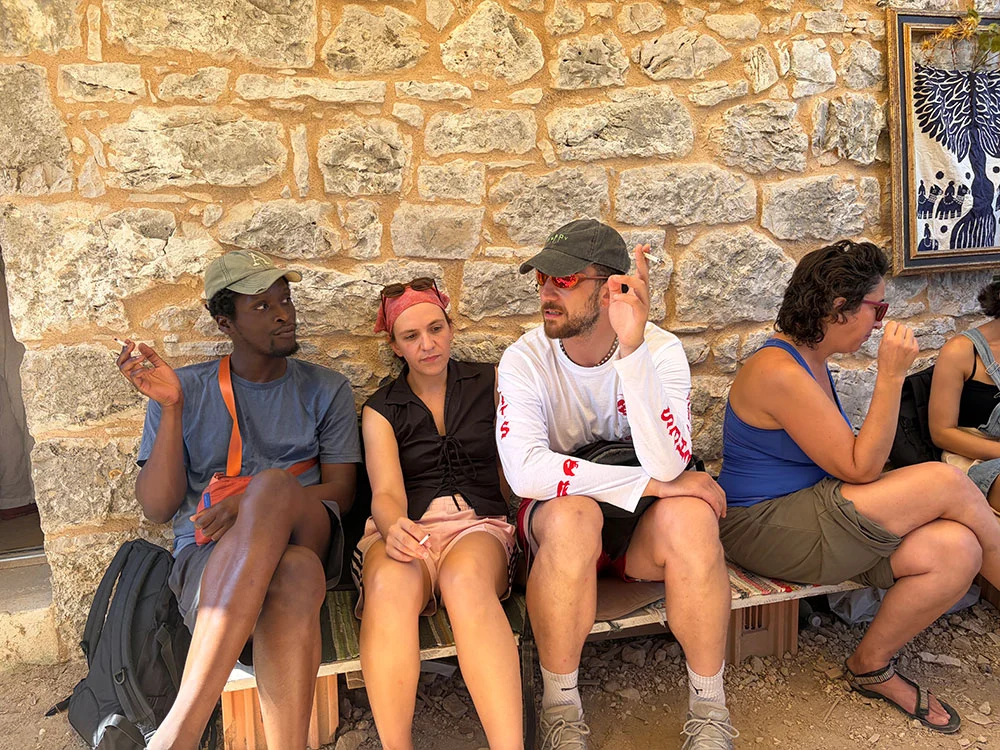
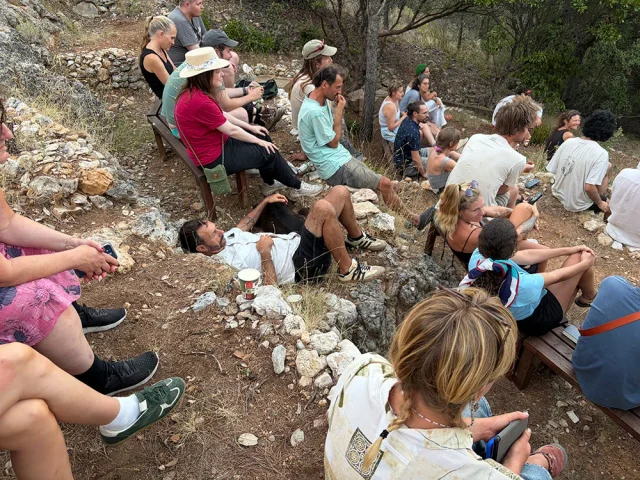
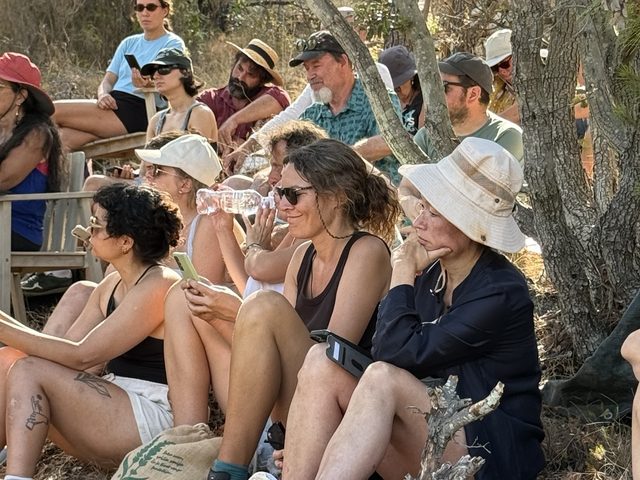
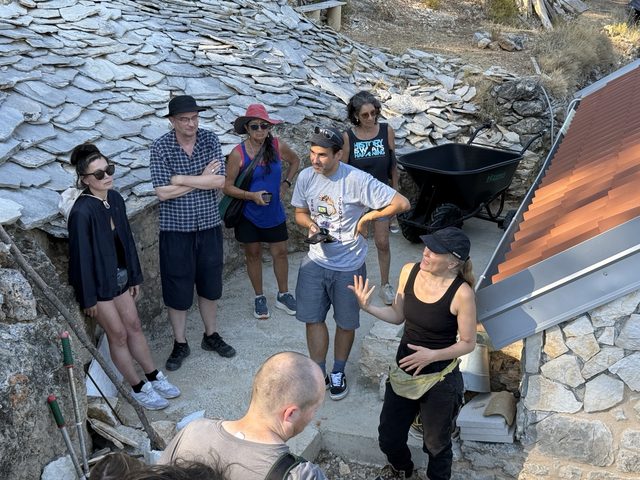
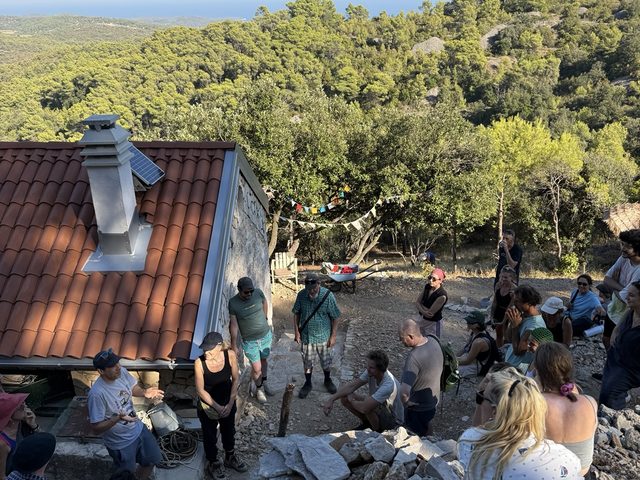
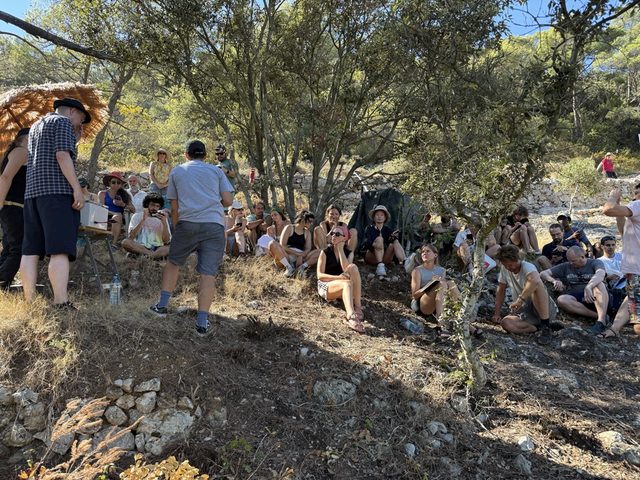
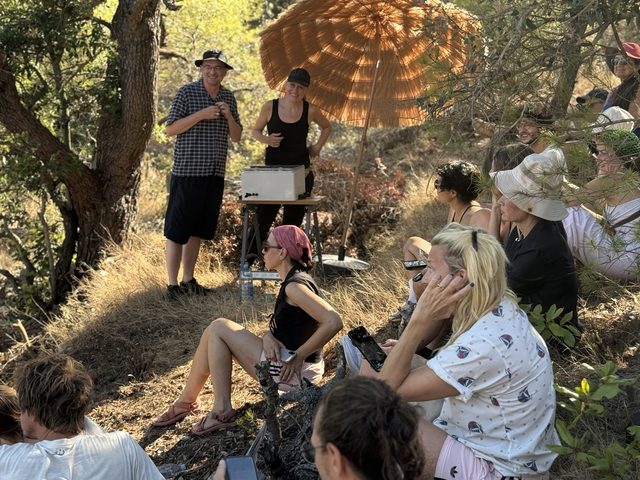
The final destination was the island of Vis where ISSA (Island School of Social Autonomy) was a host. In a way, it is a core group inside the project, with its known history of clear and efficient building of autonomous structures of the sort that is easily connected to Ivan Illich. Arriving at the final destination, Allen, previously a guest of the school, stated: “At ISSA, people are building a place, carrying materials, making walls, developing water systems, sharing knowledge, and trying to determine collectively what infrastructure is actually necessary for living together. ISSA itself describes autonomy not as isolation or self-sufficiency but as cooperative self-governance within larger networks of human and non-human interdependence.” The program on the hill, near the small stone house with the library, covered different activities. Part of the able-bodied participants picked up the task of building of the stone walls where previous groups left of and the next ones, already arriving in October, will continue. Others prepared a simple meal and a lot of Turkish coffee. One workshop was held in the shade of the trees and an exposé, followed by the discussion, took place in the amphitheatre which is under construction.
A workshop ‘Tools for Autonomy’ was prepared by !Mediengruppe Bitnik, Gordan Savičić and Felix Stalder. Together with participants, they installed a solar powered webserver at ISSA that is active only when there is enough sun. The question to answer was – how could these independent servers be networked so one machine takes over from the others to ensure that the network is always ‘on’?6 With that goal in mind, they did not only placed the stand-alone server on the roof of ISSA, but also connected it to the Solarprotocol7, a trust-based network of solar servers around the world which take over hosting-duties from each other. Protocol is led by the artists Tega Brain , Alex Nathanson and Benedetta Piantella. By becoming a node in this network, ISSA becomes in charge of hosting the website whenever the sun allows. During the week of the event, the group that lead the workshop took over stewardship of the network from a solar-server in Australia in the morning and handed over hosting duties to a server powered in Brooklyn in the late afternoon. At the end of the workshop, the sound of Cicadas was used to demonstrate the possibilities of the tools for autonomy and to host a collective cicada concert. The circle is widening. The additional node will cover Zurich University of the Arts, where Felix Stalder teaches, and students will be able to explore and play with the Protocol. It will be installed on the roof of the university next Spring.8
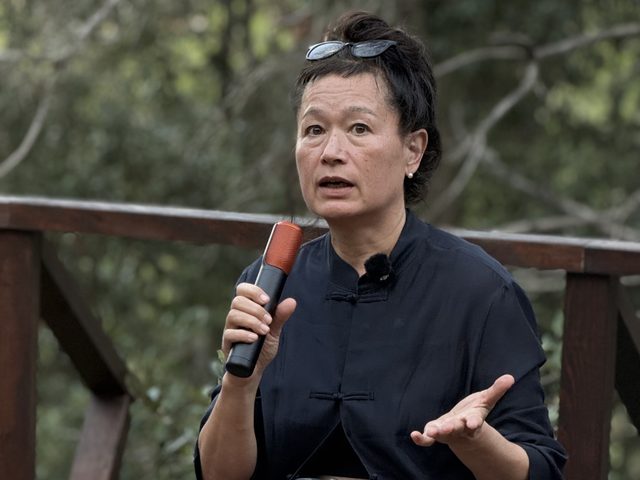
Another aspect of reality connected with technology, this time from the angle of big tech and politics, was the main subject of the lecture on the hill, presented by Hito Steyerl. For this well-known German artist, writer, and innovator it was another visit to the island and the school she has been supporting from its inception. The ideas she offered for the discussion are from her forthcoming work, soon to be published in New Left Review, entitled “Ruins at Scale – Generative AI, war and the Pantheon data centre in Topusko”. The main intention of the work is to challenge, from various standpoints, the Pantheon project, deeply controversial AI and data centre development in Topusko. It has been in the media as one of the largest infrastructure investments ever in Croatia with an alleged value of 50 billion euros. It is worth mentioning that the figures are declining, with investment now at around 15 billion euros, and the 6,000 jobs mentioned a few months ago have now been estimated 1,500 permanent ones with an additional 3,000 temporary jobs during the construction phase. Also, so far, an anchor tenant does not exist and the environmental impact assessment has not even been initiated. Steyerl clarifies the profile of the main player, “Pantheon Atlas LLC”, as an investment vehicle through which US institutions and anonymous individuals deploy capital. “The figurehead, Ryan Rich, is rich, and not much else… His only documented project as a developer was planned recently with his brother: a cannabis farm in Alden, New York. He has no proven experience with AI infrastructure. His local partner for this project is Croatian hotel magnate Jako Andabak.”
The region of Topusko in Croatia, close to the Bosnian border, is correctly described as a space not spared by the past. “Here, wars, a health resort, massacres, sheep, world class brutalism, displacement, empires, Frontex, partisan conferences, heartbeat sensors and quantum physics overlap. Artificial Intelligence is planning the next land grab.” In the past Habsburgs, Ottomans, and the Nazis’ Croatian puppet state, the NDH, left their mark. In the 90s, during the Operation Storm, many of its 7.000 inhabitants have had to flee, and those who stayed or have returned amount only a third of that number. And today, migrant routes and Frontex are ensuring sad dynamics in the place that was ones a fashionable spa resort and later a partisans’ stronghold. ´The frontier emerges as yet another militarized testing ground for AI technology, an engine-camera run on persons who may have fled the same Iran war that prompted Pantheon to avoid the Gulf in the first place.” And to choose Topusko as, for the moment, safer spot. Pantheon AI in that context “looks like a component of a broader geopolitical tech and fossil corruption proposition. Gas pipelines, LNG terminals, and AI infrastructure consolidate US ambitions in Central and Southeastern Europe, in the form of a new Golden Calf breathing fossil emissions and heralding secretive high tech.”
Participants of this event, organized by ISSA, had a chance to learn a lot from Hito Steyerl. And that is exactly one of the school’s main aims – to listen to each other, discuss, and envisage alternatives to the murky offers from the wealthy and the powerful. Steyerl also spoke about alternative ideas, for example an artist center, a data self-management facility in the vein of former local workers self-management strategies, the equal league of nations that Ivan Supek imagined to be necessary for human-friendly technology, the headquarters of the international AI regulatory body, that AI engineers and scientists keep asking for in endless open letters. She didn’t forget to mention that the land on which Pantheon AI is planned partially belongs to Mile Bajić and his family. He doesn’t want to hear anything about selling. “We were without electricity for 10 years, we didn’t give up, and I don’t intend to now either. Selling is not an option – over my dead body. “
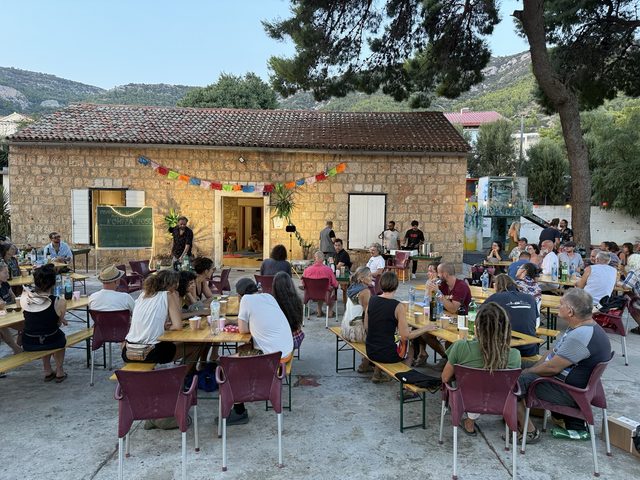
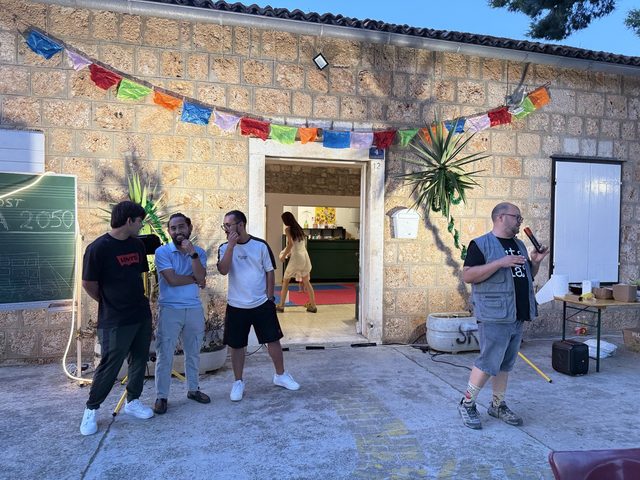
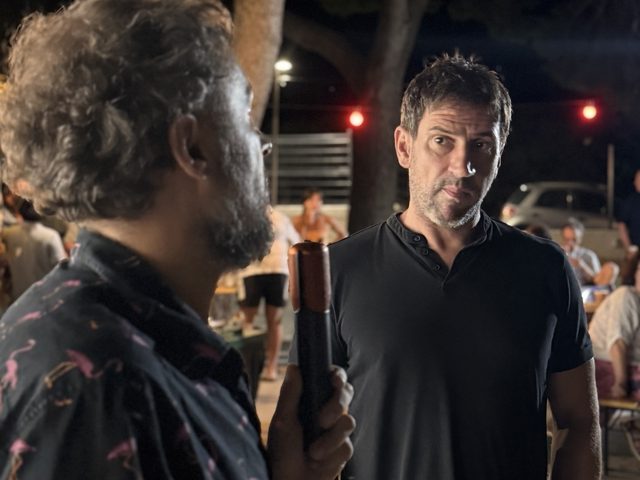
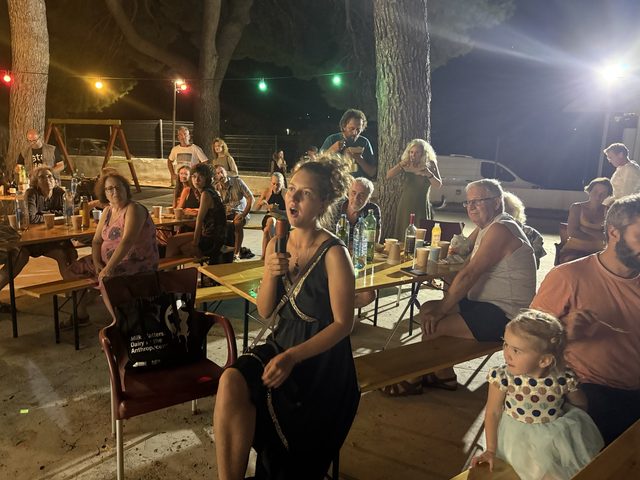
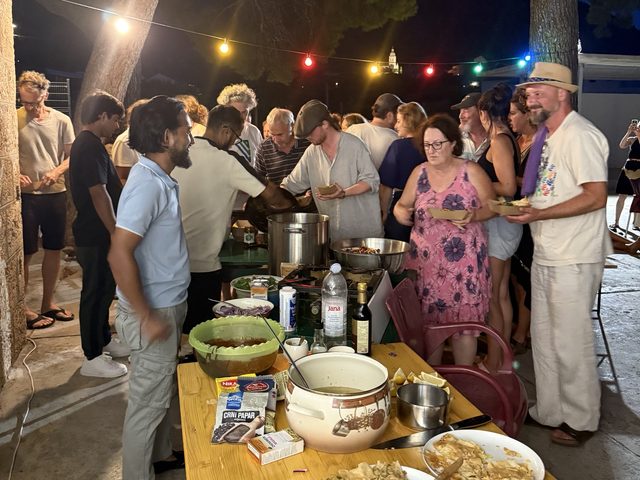
A dinner with locals in Komiža was the last item on the agenda and took place on the 9th of September. Founders and friends of ISSA had a few good reasons to organise it: respect for the people on whose island they appeared, acknowledging the importance of close interpersonal contacts, and the fact, confirmed by many studies, that mountain and island inhabitants form close communities, not always easy to penetrate. Besides, no scientific study is needed to know that a joint meal can be a door-opener. The theme of the evening was “Komiža 2050” which encouraged the discussion of the future of the island in today’s world. Srećko Horvat, Goran Bogdan, Saša Savanović and Predrag Kolaković did their part concerning the concept. Opening the event, Horvat stressed: “What kind of Komiža do we want to leave to the children who are four years old today? Do we want them to ask us in 2050: ‘Why did you know it was coming, yet did nothing?’… Or do we want them to say: ‘It is good that you started thinking about it back then’. We may not know what the sea will be like. We cannot know exactly what the temperature will be. We cannot know how many tourists will come. We cannot know what kind of fish will be caught. But we can decide something else. We can decide how we will prepare. How we will conserve water. How we will care for the land. How we will protect the sea. How we will reduce and manage waste. How we will protect the island from fire. How we will build. How we will live. How we will welcome the people who come to live and work among us.”
Some 100 people gathered in an open, communal space including visitors who came by the boats, members of ISSA and residents of the town. Kevin Kenjar, anthropologist and cook, with Nepalese friends presently working on the island, prepared an original dinner combining blitva and Nepalese way of cooking. Nobody displayed the inclination to break up the party. It was, as envisaged, one of many gatherings to come…
- https://memoof.me/read/899/pdf ↩
- https://issa-school.org/reflections/illich-silence-is-a-commons/ ↩
- https://issa-school.org/essay/islands-of-conviviality/ ↩
- Islands of Conviviality – ISSA- Island School of Social Autonomy ↩
- https://issa-school.org/guidelines/ ↩
- https://issa-school.org/solarserver/ ↩
- https://solarprotocol.net/ ↩
- https://www.zhdk.ch/en/researchproject/on-off-heliophilic-spaces-613197 ↩